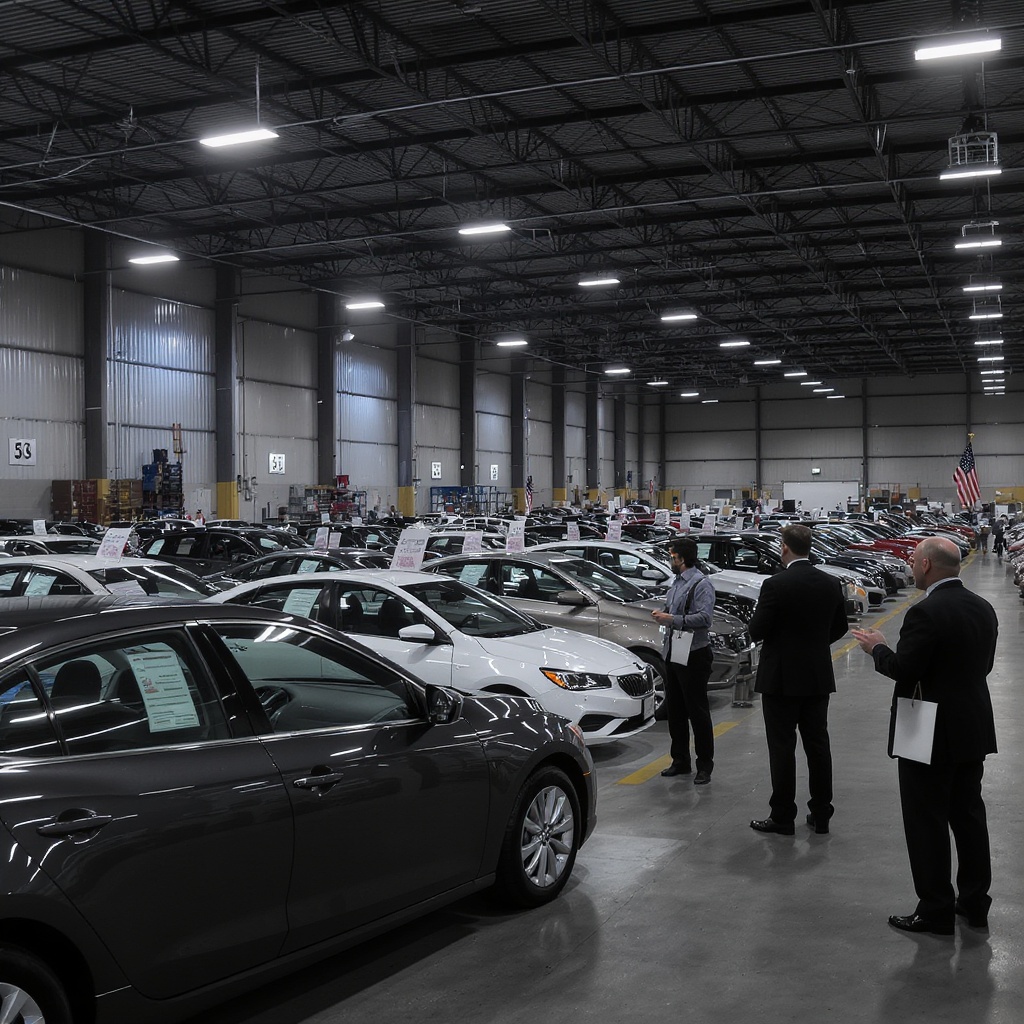
Car Flipping Wholesale — The Gateway to Profitable Deals
The dealership sits at the edge of the parking lot like a monastery — serene on the outside, impenetrable from within. You have driven here countless times. You have stood where I once stood: in the crosshairs of a salesman who sees you not as a person, but as a commission. He speaks in percentages. He bends the truth like a branch, testing how far it will bend before you break.
But the wholesale world — that is a different road entirely.
In car flipping wholesale, the rules change. The obstacle you once faced becomes the passport you now carry. The dealer's gate that once kept you out is now the door through which you walk, head high, papers in hand.
I learned this the way I learned everything: by walking through the door anyway.
Three years ago, I stood in a dealership lot with $4,200 in my pocket and a dream I could not yet name. The car I wanted cost $6,800. The salesman offered me $5,900 with conditions that would have buried me in debt. I walked away. Not in defeat — in refusal. I had read somewhere that the universe rewards those who do not accept the first version of the story.
Six months later, I held a wholesale dealer's license. I walked back onto that same lot and bought my first car at $3,100. I sold it six weeks later for $5,800. Not a miracle. A method.
This guide is that method. Not a get-rich-quick scheme — a gateway. And like every gateway, it requires a key.
The Dealer License — Your Passport to Wholesale
The dealer license is the key. Not metaphorical — literal. In most states, you cannot legally purchase vehicles at wholesale prices — the prices auction houses, dealer-only lots, and manufacturer direct programs offer — without a valid dealer license.
The objections are predictable. It's expensive. It takes months. The paperwork is endless. These are the same objections every gatekeeper uses to keep you on the outside.
In California, a dealer license runs approximately $700-1,500 depending on your county. In Texas, the fee is under $300. Most states require a lot space — a physical location where vehicles can be displayed — and most will accept a commercially-zoned storage unit. You do not need a showroom on Sunset Boulevard. You need a door that opens.
The license unlocks three things: access to dealer-only auctions (Copart, IAAI, and Manheim offer dealer-tier pricing 20-60% below retail), wholesale pricing from private sellers (they quote you dealer wholesale when you show your license), and tax savings that improve net margins on every flip.
Where the Real Deals Hide
Once you have the license, the world rearranges itself. Cars that were invisible to you become visible. Prices that were locked become negotiable.
Copart and IAAI are the two largest salvage/dealer auctions in the United States. Each week, tens of thousands of vehicles are listed. The trick is not finding deals. The trick is knowing which deals will yield a profit after repair, transportation, and holding costs.
A car worth flipping is one where the purchase price plus all carrying costs leaves a margin of at least $1,500-2,000 before the car sells. The math is simple. The patience required is harder.
Local dealer auctions are another channel. Every metropolitan area has auction houses that sell trade-ins, repos, and fleet vehicles. The auction sheet will tell you the story. Learn to read it. The rule is this: you are not looking for a cheap car. You are looking for a car at the right price relative to its value. Those are different things, and the distinction is the difference between a profitable flip and an expensive lesson.
The Spiritual Dimension of the Flip
The alchemist did not simply turn lead into gold. He transformed himself in the process. Car flipping works the same way.
There is a moment — you will recognize it — when you take ownership of a car that is not yet yours by any title you have earned. You feel it in your hands. You check the VIN for the third time. You look at the engine and hear, in your memory, Paulo Coelho saying that the universe conspires to help those who move toward their destiny.
That car is a chapter. Not the whole story — a chapter.
The patience required in this work is spiritual practice. You wait for the right car, not the fastest car. You pass on dozens of deals that would have worked but would not have worked well. You develop a relationship with the process, not just the profit.
I once passed on seven cars in one week because the margins were thin and the risk was high. On day eight, a 2019 Honda CR-V came through — 62,000 miles, one owner, dealer trade-in. I bought it at $14,200. Four weeks later, it sold for $18,400. The waiting was not waste. The waiting was the practice.
Turning the Flip into a Lifestyle
Here is what a sustainable car flipping practice looks like:
Timeline: 7 to 30 days from acquisition to sale. Longer than 45 days begins to erode margins through holding costs, insurance, and opportunity cost.
Budget: Reserve 20% of purchase price for repairs, transportation, and unexpected costs. If you cannot reserve this, you cannot afford the flip.
Rotation: Run 1-3 cars at a time, scaling as capital and confidence grow. Wholesale is a volume business — the margin per car is modest, but the margins accumulate.
The lifestyle follows from the practice. You build a network of mechanics, detailers, and auction agents who become your infrastructure. You learn to read a Carfax report the way a sailor reads the sky. You develop an intuition for value that no algorithm can replicate.
Each car is a chapter. The chapters accumulate into a book. The book is your business — and it runs on your terms, at your speed, in your name.
Conclusion
Car flipping wholesale is not about finding cheap cars. It is about finding yourself in a position where cheap cars become available to you — because you did the work, earned the license, and walked through the door.
The road continues. The flip is just the beginning. And in the world of car flipping wholesale, every mile teaches you something about the journey.